
 Tiếng Việt
1. What is safety mark?
Safety mark is roughly translated as Safety Mark. This is a logo designated to be used for commodity control (CG) in the Consumer Protection (Safety Claims) (CPSR) process. This amendment proposed by Enterprise Singapore to the CPSR on 15 January 2018 requires 33 categories of household products (Controlled Goods) to be tested against regulatory safety standards and affixed with a Safety Mark. completely before the product can be sold in Singapore.
Safety marks help consumers and suppliers to identify registered Controlled Goods. These goods must carry the SAFETY Mark affixed to the Controlled Goods or on their packaging (affixed in a conspicuous location). The trademark consists of a “safety logo” and the words “SAFETY MARK” in a rectangle to the right. These goods can also be traced with an 8-digit registration number unique to the registrant and registered samples.
In addition, devices with 3-pin plugs need to have two SAFETY Marks on them. One on the device and one on the plug itself, for example the image below:

In order to protect their rights and avoid unfortunate risks, Consumers are also a contributing factor to keeping themselves and their families safe by looking for the SAFETY Sign when buying electrical appliances, electronics and household gas on the market.
The Consumer Protection Regulations (Safety Requirements) (CPSR) require that 33 types of electrical, electronic and household gas appliances and accessories, also known as Controlled Goods, be inspected. according to specific safety standards and are given the SAFETY Mark before they can be sold in Singapore. These include safety checks against fire, electric shock, explosion, and other hazards that could result in injury, death, or property damage.
Consumers are advised to purchase only Controlled Goods bearing the SAFETY Mark.
2. Why should we pay attention to the SAFETY Mark when buying products?
The SAFETY mark indicates that the design of the product has been tested and certified compliance with the relevant safety standards.. For most categories of equipment, the presence of the SAFETY Mark also indicates that internal safeguards have been incorporated to protect against electrical and fire hazards.
Safety signs on controlled goods:
- Ensure product meets regulatory safety requirements
- Helps prevent incidents that could result in injury or death and property damage.
- Gives manufacturers a marketing edge from the consumer’s point of view.
3. What should you do when you find that Controlled Goods are not registered and do not have a SAFETY Mark?
The Consumer Product Safety Authority in Singapore takes a very strict and clear stance on any non-compliance. If you know anyone who is supplying or selling Unregistered Controlled Goods, consumers can provide the Safety Authority with relevant information such as: product type, brand/model, company name company, location, etc. so that appropriate enforcement action can be taken to compel the supplier to comply with the Product Regulations. Consumers in Singapore can contact the email address: consumerproductsafety@entercturesg.gov.sg or Hotline: 6898 1800.
4. Sanctions for supplying unregistered Controlled Goods
Any Person or business found guilty of selling Goods requiring registration of safety controls but not yet registered, will be liable upon conviction, up to a fine not exceeding S$10,000 or be sentenced to imprisonment for a term not exceeding 12 months, or both.
5. Controlled product registration process
Any importer or manufacturer in Singapore who intends or engages in any trade or business, supply or advertises to supply any controlled goods in Singapore shall apply to the Authority. Safety includes:
- Registered as a Registered Supplier (RS); and
- Register any controlled goods that an importer or manufacturer intends to supply or advertise for supply in Singapore.
This registration will be based on the classification of goods including:
– Low-risk controlled goods
– Commodities are controlled medium risk
– High-risk controlled goods
Registration process:
Step 1: Register with Enterprise Singapore, Safety Authority, to become a Registered Supplier (RS)
Step 2: Make and issue required test report(s). If not available, RS can contact conformity assessment bodies (CABs) for controlled product testing (CG – Controlled Goods).
Step 3: Determine which commodity belongs to which risk category: low, medium, high.
Step 4: [For low-risk CG] RS submits the Supplier Declaration of Conformity (SDoC) to the Safety Authority based on the test report. In doing so, RS is self-declaring that low-risk CGs comply with Safety Authority requirements.
Step 5: [For medium and high risk CGs] RS submits test reports and other related documents to a CAB (Certification Authority) for evaluation. If the CG meets the safety requirements, the CAB (Certification) will issue a Certificate of Conformity (CoC) and submit the CoC to the Safety Authority.
Step 6: If the Safety Authority judges that the Application is correct and satisfactory, a Letter of Acceptance (LOA) will be issued to the RS.
The term of the certification is 3 years and is renewable.
6. 33 types of Controlled Goods
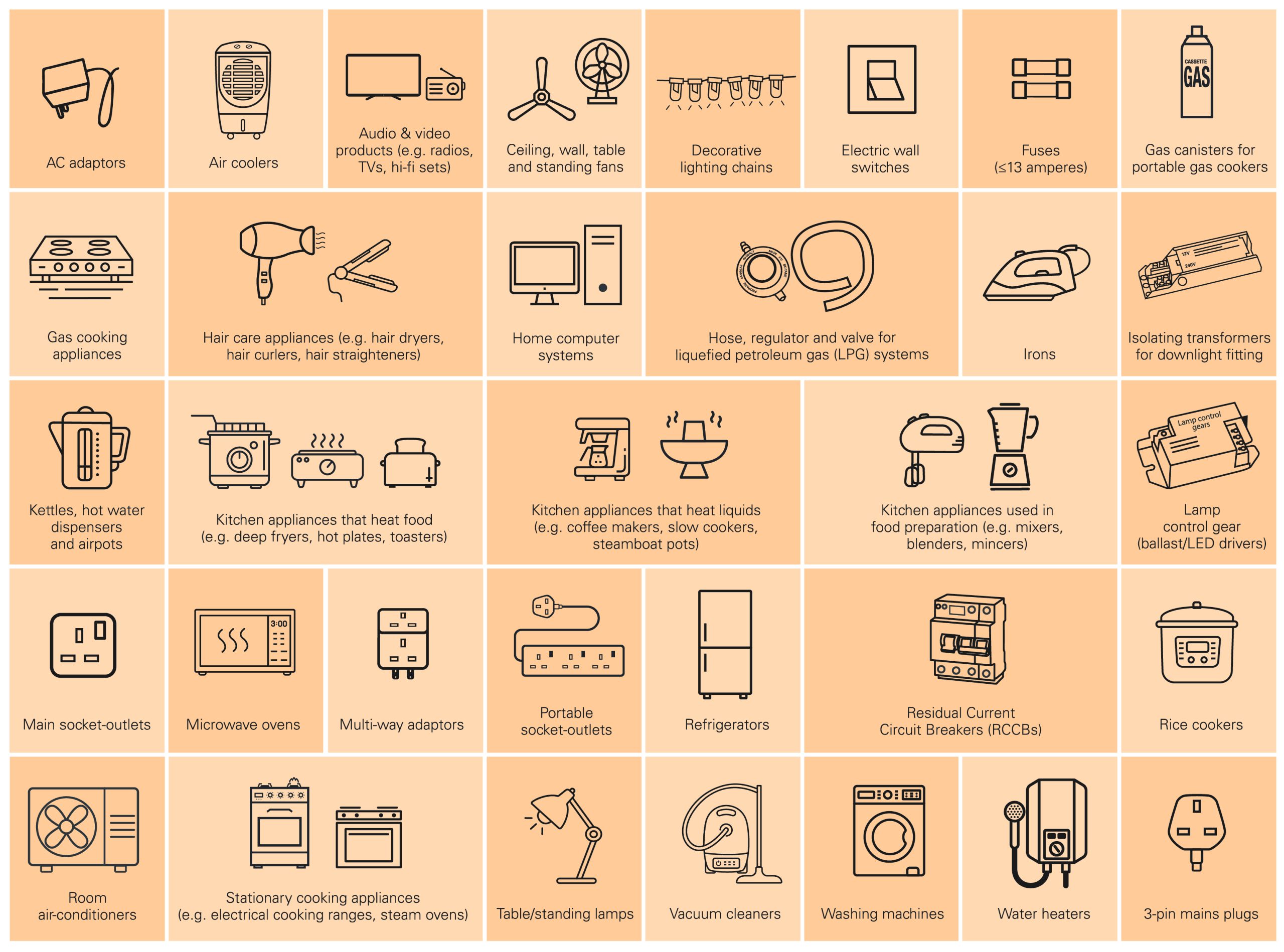
| CONTROLLED GOODS | ||
| No. | Type, class or description of controlled goods | Effective date |
| 1 | Audio and video products, which are electronic devices for home entertainment designed to be fed from the supply mains and intended for reception, generation, recording or reproduction, respectively of audio, video and associated signals, with rated voltage of not more than 250 Vac. | 15-Jan-18 |
| 2 | Fans, limited to ceiling, table, standing and wall fans, which are electrical appliances for circulating the air in its vicinity and intended for household use, with rated voltage of not more than 250 Vac. | 15-Jan-18 |
| 3 | Gas cooking appliances, limited to built-in, table, free standing and portable gas cookers, which are cooking appliances intended for household use that use gas or liquefied petroleum gas obtained from a non-refillable gas canister up to 1.4 litres as fuel. | 15-Jan-18 |
| 4 | 3-pin mains plugs, limited to 13-amp rectangular types and 15-amp round types, which are portable devices that have rectangular or cylindrical projecting pins designed to engage with the contacts of a corresponding socket-outlet. 3-pin mains plugs also incorporate means for the electrical connection and the mechanical retention of a suitable flexible cord. | 15-Jan-18 |
| 5 | 3-pin portable socket-outlets, including portable cable reels, which are electrical accessories intended for household use that have at least a set of 13-amp shuttered socket-outlets with flexible cords, and which can be easily moved from one place to another while connected to rated voltage supply of not more than 250 Vac. | 15-Jan-18 |
| 6 | Mains socket-outlets, which are electrical devices that have 13-amp or 15-amp switched shuttered socket-outlets in a single or multiple arrangements, to engage with the pins of a corresponding plug designed for flush mounting in a suitable box or for surface or panel mounting. | 15-Jan-18 |
| 7 | Water heaters, limited to instantaneous and storage types, which are electrical appliances intended for household use to heat water below boiling temperature, with rated voltage of not more than 250 Vac. | 15-Jan-18 |
| 8 | Stationary cooking appliances, limited to cooking ranges, hobs and ovens, which are electrical stationary appliances intended for household use for cooking, with rated voltage of not more than 250 Vac for single-phase and 480 Vac for three-phase. | 15-Jan-18 |
| 9 | Hair care appliances, limited to hair dryers, hair curlers, hair straighteners and hair stylers, which are electrical hand-held appliances intended for household use to dry or care for human hair, with rated voltage of not more than 250 Vac. | 15-Jan-18 |
| 10 | Liquid heating appliances, limited to kettles, airpots and hot water dispensers, which are electrical appliances intended for household use to heat liquids for consumption that have a rated capacity not exceeding 10 litres, with rated voltage of not more than 250 Vac. | 15-Jan-18 |
| 11 | Toasters, grills, roasters, hot plates, deep fryers and similar appliances, which are electrical appliances intended for household use that use heated medium such as air and cooking oil for food preparation, with rated voltage of not more than 250 Vac. | 15-Jan-18 |
| 12 | Lamp control gear, which is an electrical device intended for household electrical installation that limits the current of the lamp or supplies constant current or constant voltage to power LED lighting. | 15-Jan-18 |
| 13 | Air cooler, which is an electrical appliance intended for household use to agitate the air and equipped to use water as a cooling medium, with rated voltage of not more than 250 Vac. | 15-Jan-18 |
| 14 | AC adaptor, which is a device with rated voltage of not more than 250 Vac, and designed to supply a.c. or d.c. power for applications such as computers, telecommunication equipment, home entertainment equipment or toys. | 15-Jan-18 |
| 15 | Coffee makers, slow cookers, steam boats and similar appliances, which are electrical appliances intended for household use to heat liquids for the purpose of food or beverage preparation, with rated voltage of not more than 250 Vac. | 15-Jan-18 |
| 16 | Decorative lighting chain, which is an electrical lighting chain intended for household use and fitted with a series or parallel or combination of series or parallel connected light emitting devices, with rated voltage not exceeding 250 Vac. | 15-Jan-18 |
| 17 | Home computer system (inclusive of monitor, printer, speaker and other mains operated accessories), which is a microcomputer and its associated accessories, intended for household use, with rated voltage of not more than 250 Vac. | 15-Jan-18 |
| 18 | Iron, which is an electrical hand-held appliance intended for household use, with a heated soleplate for smoothing or pressing fabric, including those with a separate water reservoir or boiler having a capacity not exceeding 5 litres, with rated voltage of not more than 250 Vac. | 15-Jan-18 |
| 19 | Microwave oven, which is an electrical appliance intended for household use that uses high-frequency electromagnetic waves for heating food or beverages, with rated voltage of not more than 250 Vac. | 15-Jan-18 |
| 20 | Kitchen machines, including mixers, blenders and mincers, which are electrical appliances intended for household use to prepare food or beverages, with rated voltage of not more than 250 Vac. | 15-Jan-18 |
| 21 | Refrigerator, which is an electrical appliance intended for household use that operates on the vapour compression principle for food storage and preservation, with rated voltage of not more than 250 Vac. | 15-Jan-18 |
| 22 | Rice cooker, which is an electrical appliance intended for household use to cook rice, with rated voltage of not more than 250 Vac. | 15-Jan-18 |
| 23 | Room air-conditioner, which is an electrical appliance intended for household use and designed as a self-contained unit for mounting on a window or through a wall to provide conditioned air to an enclosed area, with rated voltage of not more than 250 Vac. | 15-Jan-18 |
| 24 | Table or standing lamp, which is an electrical portable general purpose luminary intended for household use with supply voltage of not more than 250 Vac. | 15-Jan-18 |
| 25 | Vacuum cleaner, which is an electrical portable appliance intended for household use to remove dirt or dust, with supply voltage of not more than 250 Vac. | 15-Jan-18 |
| 26 | Washing machine, which is an electrical appliance intended for household use to wash clothes and textiles, with rated voltage of not more than 250 Vac. | 15-Jan-18 |
| 27 | Components of the Liquefied Petroleum Gas system: | 15-Jan-18 |
| (a) | Hose, namely a hose intended for household use in liquefied petroleum gas vapour phase and liquefied petroleum gas or air appliances not exceeding 5 KPa (50 mbar) operating pressure; | |
| (b) | Regulator, which is a non-adjustable device intended for household use that maintains the outlet pressure constant at a nominal value up to and including 50 mbar, independent, within specified limits, of inlet pressure or flow rate; | |
| (c) | Valve, which is a device that is made from brass, bronze or aluminium forging, intended for household use with liquefied petroleum gas cylinders, to control the direction and volume of flow of the liquefied petroleum gas. | |
| 28 | Gas canister, which is a non-refillable metallic container up to 1.4 litres capacity filled with liquefied petroleum gas intended for household use with a portable gas cooker. | 15-Jan-18 |
| 29 | Fuse (13-amp or less) for use in a 13-amp plug, which is a device that, by the fusion of one or more of its specially designed and proportioned components, opens the circuit in which it is inserted and breaks the current when this exceeds a given value for a sufficient time. | 15-Jan-18 |
| 30 | Multi-way adaptor, which is intended for household use, has more than one set of socket contacts, and which may or may not be of the same type or rating as the plug pin portion. | 15-Jan-18 |
| 31 | Domestic electric wall switch, which is an electrical manually operated general purpose switch for alternating current only, with a rated voltage not exceeding 440 V and a rated current not exceeding 63 A, intended for household fixed-electrical installations. | 15-Jan-18 |
| 32 | Residual current circuit breaker (RCCB), which is an electrical device intended for household fixed-electrical installation with sensitivity of 30 mA intended to protect persons against indirect contact, the exposed conductive parts of the installation being connected to an appropriate earth electrode. | 15-Jan-18 |
| 33 | Isolating transformer for downlight fitting, which is an isolating transformer intended for household electrical installation with input and output windings that are electrically separated to limit hazards due to accidental simultaneous contact with earth and live parts or metal parts that may become live in the event of an insulation failure. | 15-Jan-18 |
If you need more information about Safety mark in Singapore, please contact MGC for advice and support